ISRAEL: Jerusalem, Bethlehem, Nazareth and Galilee
April 13-15, 2017

Sea of Galilee
...But this is not where my days began in Israel. Jerusalem was my first tour, so I'll start this blog there. Also a disclaimer... most of the narrative is what we heard from our guides or received in brochures; not necessarily my thoughts or opinions. But some personal thoughts are intermingled with this documentation.
Some quoted scriptures are from KJV and others from NIV or another version.
 Ashdod
Ashdod was settled during the Canaanite era in the 17th century BC, making it one of the most ancient cities in the world. Even the Bible mentions Ashdod, then a Philistine city. Now, it is Israel's largest port. We cruised all night and arrived in Ashdod at 7A.M. I was excited to get off and see Jerusalem. Probably the only port I've come into or out of that I failed to take even one photo. There is so much to do and see here, a person could stay for weeks, months even years and not see and do it all. However, I just wanted some highlights for this time, since my time was so limited here... only one day! We were required to keep our passports with us at all times. We would leave this port about 10 P.M. and go to Haifa for the next day. We had a early bus, and we were off...
...But this is not where my days began in Israel. Jerusalem was my first tour, so I'll start this blog there. Also a disclaimer... most of the narrative is what we heard from our guides or received in brochures; not necessarily my thoughts or opinions. But some personal thoughts are intermingled with this documentation.
Some quoted scriptures are from KJV and others from NIV or another version.

Ashdod was settled during the Canaanite era in the 17th century BC, making it one of the most ancient cities in the world. Even the Bible mentions Ashdod, then a Philistine city. Now, it is Israel's largest port. We cruised all night and arrived in Ashdod at 7A.M. I was excited to get off and see Jerusalem. Probably the only port I've come into or out of that I failed to take even one photo. There is so much to do and see here, a person could stay for weeks, months even years and not see and do it all. However, I just wanted some highlights for this time, since my time was so limited here... only one day! We were required to keep our passports with us at all times. We would leave this port about 10 P.M. and go to Haifa for the next day. We had a early bus, and we were off...
Jerusalem & Bethlehem, April 13th
Since its foundation in 1901, the JNF has planted over 250 million trees in Israel.

The messianic vision of the Jews’ return to their homeland, therefore, necessarily includes reforestation. It is a massive effort fueled by the simple desire to plant trees in Israel. Since its foundation with Theodor Herzl’s help in 1901, the JNF has planted over 250 million trees in Israel. The organization has also built 250 dams and reservoirs. Creating forests requires ecologic research, planning, and water infrastructure. “Planting a tree is symbolic of planting our Jewish roots in the Land of Israel.” We continue on our mission of planting trees and adding to the 250 million that populate Eretz Israel,”
Jerusalem


Then my first view of the Western Wall of the Temple, in the Old City of Jerusalem and the golden dome. The Dome of the Rock is the oldest Islamic monument. Jews believed, and still believe, the rock to be the very place where Abraham prepared to sacrifice Isaac (an event which Muslims place in Mecca). In addition, the Dome of the Rock (or the adjacent Dome of the Chain) is believed by many to stand directly over the site of the Holy of Holies of both Solomon's Temple and Herod's Temple. The golden dome that crowns the Dome of the Rock was originally made of gold, but was replaced with copper and then aluminum. The aluminum is now covered with gold leaf, a donation from the late King Hussein of Jordan.


Brigham Young University in top left corner the photo below has a panoramic view of Jerusalem. The 1980s saw not only Mormons, but many Christian groups vying for representation and space in the city. Because of its prominent location in the Jerusalem skyline, construction was quickly noticed, and this sparked a major controversy in Israel and in the Jewish world as a whole beginning in 1985. The Haredim led the opposition, their main concern being that the building would be used not as a school, but as a center for Mormon proselyting efforts in Jerusalem. The Haredim warned of a "spiritual holocaust". The LDS Church, they argued, had no local presence in the population of the Jerusalem area and no historical connections to the land. The group spread warnings through letters, newspapers, and television that Mormon missionaries would convert Jews throughout the city, saying that: "The Mormon organization is one of the most dangerous, and in America they have already struck down many Jews. At the present the Mormons are cautious because of the tremendous opposition their missionary activities would engender, but the moment their new Center is completed, we won’t be able to stop them." Warnings in the media led to street protests and demonstrations. Orthodox Jews marched on City Hall and to the construction site in 1986. Some even gathered at the Western Wall in a public prayer of mourning because of the center. They also gathered at the hotel at which the BYU President was staying at one point, carrying signs saying: "Conversion is Murder!" and "Mormons, stop your mission now". Despite the intensity of the Haredi opposition, at no point did the protests become physically violent. In late 1985, the Haredim motioned for a no-confidence vote against the leading Labor Party. Prime Minister Shimon Peres organized a committee of eight, four for the center and four against, to debate the issue and come up with a solution either for or against the center's presence. Another committee was formed to look into the allegation that the money the church had put into Jerusalem was a bribe to gain Mayor Kolleck's support for the center (the committee found the church "Not Guilty"). A subcommittee of the Knesset requested that the LDS Church issue a formal promise not to proselytize Jews. Some Israelis considered this discriminatory, as no other Christian church had been asked to do this in Jerusalem. Church leaders, however, agreed to comply and sent a formally signed statement soon after. Some Jews in the area were still uneasy and doubted the church's intent, believing that religious belief among Mormons would supersede adherence to the law. One protester stated that "converting the sons of Judah, us, is a basic article of their faith. . . . They regard themselves as sons of Joseph and believe there will be no Second Coming for as long as we and they do not fuse."

The land on which the center was built was then still considered Arab land by many, and many officials saw that its lease would add an image of religious tolerance to their government and increase Israeli control of the land.

Mount of Olives
The Mount of Olives is frequently mentioned in the New Testament (Matt. 21:1; 26:30, etc.) as part of the route from Jerusalem to Bethany and the place where Jesus stood when he wept over Jerusalem. Jesus is said to have spent time on the mount, teaching and prophesying to his disciples (Matt. 24–25), including the Olivet discourse, returning after each day to rest (Luke 21:37, and John 8:1), also coming there on the night of his betrayal (Matt. 26:39). At the foot of the Mount of Olives lies the Garden of Gethsemane. The New Testament tells how Jesus and his disciples sang together – "When they had sung the hymn, they went out to the Mount of Olives" Matt. 26:30. Jesus ascended to heaven from the Mount of Olives according to Acts 1:9–12.

Standing on the Mount of Olives looking toward the Western Wall. At the foot of the Mount of Olives is the Garden of Gethsemane. The Mount of Olives is a two-mile long ridge, or foot hill, with three summits on it. Just to the east of the Mount of Olives is the wilderness (desert) that leads down to Jericho and the Jordan Valley. It is named after the groves of olive trees that grew there in the Old and New Testament times.

The Mount of Olives is first mentioned in connection with David's flight from Absalom (II Samuel 15:30): "And David went up by the ascent of the Mount of Olives, and wept as he went up." The sacred character of the mount is alluded to in the Ezekiel (11:23): "And the glory of the Lord went up from the midst of the city, and stood upon the mountain which is on the east side of the city."
The biblical designation Mount of Corruption, (I Kings 11:7–8), derives from the idol worship there, begun by King Solomon building altars to the gods of his Moabite and Ammonite wives on the southern peak, "on the mountain which is before (east of) Jerusalem" (1 Kings 11:7), just outside the limits of the holy city. This site was known for idol worship throughout the First Temple period, until king of Judah, Josiah, finally destroyed "the high places that were before Jerusalem, to the right.. "(II Kings 23:13)
Looking back across the Kidron valley at all the tombs on the hillside of the Mount of Olives. The Mount of Olives has been used as a Jewish cemetery for over 3,000 years and holds approximately 150,000 graves.

Looking from the Temple mount. The Mount of Olives was the burial place of Jerusalem during the time of the Biblical kings. Prime Minister of Israel Menachem Begin asked to be buried on the Mount of Olives near the grave of Etzel member Meir Feinstein, rather than Mount Herzl national cemetery. As of 2010, the Jewish cemetery on the Mount of Olives has been targeted regularly by Arab vandals. Mourners have been assaulted. Notable graves that have been defaced by vandals include those of the Gerrer Rebbe and Menachem Begin.

Looking up from the bottom of the Kidron Valley at 2000 year old tombs cut into the west side of the Mount of Olives. The three tombs from left to right: Ben Hezir, Zechariah and an unfinished tomb.

This tomb is just a little further north of the three previously mentioned tombs in the Kidron Valley. It was constructed during Jesus’ lifetime. Today it is traditionally called the Pillar of Absalom or Absalom’s Monument. The Bordeaux Pilgrim referred to it as the Tomb of Hezekiah in 333 AD. It was first associated with Absalom by Benjamin of Tudela in 1170 because of 2 Samuel 18:18. The actual person or family for whom this tomb was prepared is unknown. The architectural style includes both Egyptian and Greek influences, which would have come from the two kingdoms that dominated Judea between 300-100 BC. The Egyptian influence came from the Ptolemys of Egypt, and the Hellenistic style from the Seleucids, who were Greeks ruling in Syria. The lower square is cut from the bedrock. It is topped with a finely-cut circular stone with a conical top that was cut from one single stone. Directly to the left of this tomb is an eight-chambered catacomb with well-preserved carved stone. The catacomb is called the Cave of Jehoshaphat. The Pillar of Absalom may have been a monument for the burial chambers in the Cave of Jehoshaphat, cut into the cliff behind it. There are two inscriptions in this monument. A two-line inscription above the door is from around 400 AD that says: “This is the tomb of Zachary, martyr, most holy priest, father of John the Baptist.” A later inscription can be seen to the right of the door but only the word “simon’ can be made out.

Kidron Valley
Looking down the valley, Tombs on center left
It is important to realize that the Kidron Valley was much deeper 2,000 years ago. The bottom of the Kidron Valley has been raised by the rubble and debris of centuries falling into it. This is where Jesus was tempted by Satan to jump: Then the devil took him to the holy city and had him stand on the highest point of the temple. “If you are the Son of God,” he said, “throw yourself down.” Matt. 4:8

The wall we call today the Western Wall, while not a part of the Holy Temple itself, was part of the Temple Mount retaining wall that Herod the Great built in the 1st century BC when he ambitiously expanded the Temple Mount and renovated the then-dilapidated Second Temple.

The GOLDEN GATE – You will notice is closed, The Moslems/Muslims 'know' the Jewish Messiah will come through this Gate, so they filled it with 16 feet of cement. They also know a Gadol Cohen (High Priest) can’t walk in a graveyard so they bury their dead there. The Golden Gate faces the Mount of Olives on the East wall of the Old City. The Golden Gate was constructed in the post-Byzantine period and the Muslims sealed the gate during the rule of Suleiman. (A Muslim in Arabic means "one who gives himself to God," and is by definition, someone who adheres to Islam. By contrast, a Moslem in Arabic means"one who is evil and unjust" when the word is pronounced, as it is in English, Mozlem with a z).

When the Romans destroyed the Temple in 69 CE, this wall was not destroyed. And nearly two thousand years later, the wall still stands. Of the visible part of the wall, only the bottom seven layers of stones, consisting of large stones with indented borders, date from Herod's project. The next section, consisting of four layers of smaller, plainer stones, dates from the Byzantine period. The next layer up was added sometime after the Moslem (Muslim) conquest in the seventh century, and the topmost layer was added in the 19th century, paid for by the famed British philanthropist and financier, Sir Moses Montefiore.


The City of David was very narrow; about 200-300 feet wide. The east side has a steep slope of about 60 degrees. Though smaller, steeper and more difficult for construction than the Western Hill, the City of David was chosen because of its water source, the Gihon Spring. The Kidron Valley borders the city on its east side.

Once a deep ravine channeling a seasonal stream, it provided a defense border to the original City of David — and a route to the wilderness for King David when he fled from his rebellious son Absalom (2 Samuel 15:23). Jesus often traversed the Kidron on his way to the village of Bethany, his favorite place of rest and refuge. After the Last Supper, he crossed the valley with his disciples to the garden of Gethsemane. Then, after he was betrayed, he was brought back the same way to the house of the high priest.


Since the 4th century, an identification of the Kidron with the Valley of Jehoshaphat (a name meaning “Yahweh shall judge”) mentioned in the book of Joel (3:2,12) has led to the belief that it will be the place of final judgment.

Garden of Gethsemane

Olive trees do not have rings and so their age cannot be precisely determined, but scholars estimate their age to anywhere between one and two thousand years old. It is unlikely that these trees were here in the time of Christ because of the report that the Romans cut down all the trees in the area in their siege of Jerusalem in AD 70.

Garden of Gethsemane at the bottom of the slope of the Mount of Olives

Jesus was betrayed in the Garden of Gethsemane by Judas Iscariot, who used a kiss to identify Jesus to the arresting soldiers. Judas was one of the 12 original disciples. One of the darkest moments in all of history is the betrayal of Jesus by one of His disciples, Judas Iscariot. When the disciples came to Jerusalem for the last time, Jesus made it clear that His death would be upcoming. You know that after two days is the Passover, and the Son of Man will be delivered up to be crucified (Matthew 26:2). Realizing this, Judas went to the chief priests and said, 'What are you willing to give me if I deliver him to you?' And they counted out to him thirty pieces of silver. So from that time he sought opportunity to betray him (Matthew 26:15). On the night when Jesus and the disciples celebrated the Last Supper, Judas plotted with the religious rulers to take them to Jesus in the Garden of Gethsemane. It was there in the garden that Jesus was betrayed and arrested.

The night before Jesus Christ was crucified, He prayed in the Garden of Gethsemane. It is in Luke’s Gospel where we see that His sweat was like drops of blood: “And being in agony, He prayed more earnestly. Then His sweat became like great drops of blood falling down to the ground” (Luke 22:44)

Adjacent to the Church of All Nations (photo below) is an ancient olive tree in the Garden of Gethsemane that they told us was 2000 years old (photo above).

The Church of All Nations, also known as the Church or Basilica of the Agony, is a Roman Catholic church located at the foot of the Mount of Olives in Jerusalem, next to the Garden of Gethsemane. It enshrines a section of bedrock where Jesus is said to have prayed before his arrest. This rock was in the open area of the Garden of Gethsemane, before it was enclosed inside the church.

Now it has been made into a shrine and many people leave 'prayer notes' on the rock.


While I was there, this group arrived all together. I don't know from where.

Jesus Tomb (or not)
While officially the Garden Tomb Association only maintains this as a possible site for Christ’s burial, some tour guides of the site are convinced of the authenticity. They note the large cistern nearby, which proves the area must have been a garden in Jesus’ day. They maintain that there are marks of Christian veneration at the tomb which also prove its sanctity throughout the ages.
In Jerusalem there are two places people believe might have been the Tomb of Jesus. The most famous is inside the Church of the Holy Sepulcher and this one referred to as the Garden Tomb. Factually the Garden Tomb could be the actual tomb used by Jesus. The area where the Garden Tomb is was covered with debris from the period of around the second century until the late 1800s. The guide said that tomb area was a rock quarry that was turned into a garbage dump, and was used as such from after the Jewish War of 132-135 until uncovered in the late 1800s. It is said in the gospel that Jesus was entombed near the place where he was crucified, near Golgotha, the place of the skull. The guide said that the formation in the hillside had been there for a very long time. There are pictures from the late 1800s showing the same image with very little change (i.e., from erosion).

I Corinthians 15:4 "And that he was buried, and that he rose again the third day according to the scriptures:" He is not there. He lives in our hearts.
Another possible tomb. This one has the stone still in the trough. How much would such a stone weigh? Depending on the type of stone used, it could weigh between 1-2 tons (2000-4000 pounds). This is quite heavy, but two men could move it into place, as the rolling stone was set inside a groove in front of the entrance, and secured from falling over by a stone wall that stood in front of tomb opening. The groove/trough was not level, but slightly sloped. To close the tomb, the stone would be rolled down the groove at a decline and come to rest in front of the entrance. The more difficult task was removing the stone. To open the tomb, the stone would have to be rolled up the groove at an incline. (Mt 27:60; Jn 19:38-42).
Given the structure of such tombs, it would not have been possible for Jesus to simply push the stone over from the inside of the tomb. He would have to roll the 2000 - 4000 pound stone back up the groove without having anything to grip. Such a feat would not be possible for one healthy man, yet alone a man who had just been beaten to a bloody pulp by the Romans.

Then from here we then drove up to the Western Wall and the Old City of Jerusalem.


Underground, especially large stones are visible on the southern and western walls today. On the west the “Master Course” consists of four stones, the largest of which weighs 570 tons and is 44 feet long, 10 feet high and 12-16 feet deep. The next largest stone in the wall is 40 feet long. The largest stone in the Great Pyramid only weighs 11 tons.

We were driving very slowly up the hill, since this was Passover week here, and thousands and thousands of people were crowded into the city, many streets were blocked, and security was at all time high.

I observed the attire of many Jews walking along, heading to the Wall.

A spodik is a tall fur hat worn by some Haredi Hasidic Jews, particularly members of sects originating in Congress Poland. Spodiks should not be confused with shtreimels, which are a similar type of hat also worn by Hasidim.

A kolpik is a type of traditional headgear worn in families of many Chassidic Rebbes (Hasidic rabbis), by unmarried children on Shabbat, and by Rebbes on special occasions. It is made from brown fur, as opposed to a spodik, worn by Polish chassidic dynasties, which is fashioned out of black fur.

Western Wall aka Wailing Wall
Now we are on top of the Wall area, having just come through the security checkpoint. Men and women went through different security entrances. Women on the right, men on the left.


The Western Wall, has figured prominently in the Jewish traditions for centuries. Thousands flock to the old stone wall. The Wall is active 24 hours a day, 365 days a year, and the cracks between the rectangular stones are crammed with paper.


JAFFA GATE – The Jaffa Gate is located on the Western wall of the Old City. This gate has a lot of history over the past 100 years. The Jaffa gate marked the end of the highway leading from the Jaffa coast and now leads into the Muslim and Armenian quarters. A road allows cars to enter the Old City through a wide gap in the wall between Jaffa Gate and the Citadel. This passage was originally opened in 1898 when Kaiser Wilhelm II of Germany visited Jerusalem. The ruling Ottoman Turks opened it so the German Emperor would not have to dismount his carriage to enter the city.


The old streets were extremely narrow and crowded.

Jesus and the Cross
The circuitous route is believed by many to follow the path that Jesus walked, carrying his cross, on the way to his crucifixion. I am a bit of a history buff, especially Biblical history and I wanted to see as much in Israel as I could, including the Stations of the Cross so we walked the Via Dolorosa; the Way of Suffering as Jesus supposedly walked carrying his cross. So for the sake of my blog, I will tell the story as it was told to us...


Walking through the gate, the first station is a few yards ahead at the present day Umariya Elementary School. Each station is marked with a medallion indicating the station in Roman numerals. As you walk through the souks in the Muslim Quarter, the first station is on your left. It is believed that it was here where Jesus was condemned to death.

Continue on the Via Dolorosa until you reach the Ecce Homo Convent, location of the second station. It was here where Pontius Pilate gave his 'Behold the Man' speech, bound Christ, placed thorns atop his head and gave him his cross. The nearby Ecce Homo archway was part of a larger gateway built by Emperor Hadrian as the entrance to the city Forum.

This location marks the first of three times Jesus fell, according to tradition.


The site where Christ met his mother. Today it is home to an Armenian Orthodox oratory.


On the corner, the fifth station is where Simon of Cyrene carried the cross for Jesus.

The path ascends at this point and we walk through a very crowded, narrow area among the souks. On the left is the sixth station, which is even more controversial. According to tradition, this is the point where Veronica wiped the face of Jesus, creating the Veil of Veronica. The Veil supposedly was imprinted with the image of Christ after she wiped his visage.

The seventh station, where Christ fell for the second time. Today the site is next to a Franciscan chapel and the intersection was the site of a major Roman crossroads.

This station is where Jesus met a group of women and stopped in order to offer them a sermon. As with so many of the stations, this one is adjacent to a religious institution, the Greek Orthodox Monastery of Saint Charalampus.

Entrance to the Church of the Holy Sepulchre, where the remaining stations of the cross are found. The Church of the Holy Sepulchre (also known as the Church of the Resurrection) is currently under the custody of six Christian sects. Three major groups—the Greek Orthodox Church, the Roman Catholic Church, and the Armenian Orthodox Church—maintain primary control over the site, and the Coptic, Ethiopian Orthodox, and Syriac communities also have a presence there. Parts of the church that are considered common areas of worship for all of the sects, including the tomb, are regulated by a Status Quo agreement that requires the consent of all of the custodial churches. On the pillar just beyond the arch is the ninth station of the cross, where Jesus fell for a third time.

X Jesus is stripped of His garments (entrance to Calvary)
XI Crucifixion: Jesus is nailed to the cross (Roman Catholic side altar)
XII Jesus dies on the cross (main Greek Orthodox altar)
XIII Jesus’ body is removed from the cross (to the left of the main altar and marked by statue of Mary) Rock of Calvary; pilgrims have believed to be the site of the Holy Cross since the 4th century.

Station XIV
Under this massive dome is an equally massive black chamber, the aedicule, the supposed tomb of Christ and the site of the final station. Several churches have access to this structure and perform mass at the site daily. There are two rooms. The first contains a fragment of the stone believed to have sealed Jesus’ tomb and the second is the tomb itself. Of course, as you saw above is this blog post, there are other locations they feel are equally likely to have been Jesus tomb. I will say again... it really doesn't matter, as Christ Rose From the Grave and He is not here!!! Just for arguments sake, here is a website that will cause you to think... http://www.jesusneverexisted.com/sepulchre.html

Now, for my thoughts. First, I want to state, I am a very devout Christian. So, don't take my thoughts about all this out of context. But I do believe man has most likely 'manufactured many of these locations or at worst exaggerated' some of them. So before I say any more about this, I want to point out that no matter the exact location, I was glad to be in the most likely location of where Jesus was.
We can never forget that Jesus did die for our sins in a most horrific way. Crucifixion was considered to be the most painful and torturous method of execution ever devised and was used on the most despised and wicked people. In fact, so horrific was the pain that a word was designed to help explain it—excruciating, which literally means “from the cross.” From His arrest in the garden until the time our Lord stated, “It is finished” (John 19:30), Scripture records only one instance where Jesus “cried out in a loud voice” (Matthew 27:46). As our sinless Savior bore the weight of the world’s sins on His shoulders, His Father looked away, causing the suffering Christ to cry out “Eloi, Eloi, lama sabachthani?”—“My God, my God, why hast Thou forsaken me?” (Psalm 22:1; Matthew 27:46). The spiritual pain of this feeling of abandonment by his Father greatly exceeded the intense physical pain the Lord endured on our behalf.
As for me, I have always wanted to visit these locations and 'see for myself', and I won't deny I was very moved and touched by them. However, there is much controversy, dissension and strife over where all these 'occasions actually occurred, and where Jesus tomb was/is and so many of these other topics that we have just 'visited'. I feel, that if God wanted us to worship 'these natural places', he would make them very obvious, however, when I read my Bible, it says, "God is Spirit, and those who worship Him must worship in spirit and truth.” John 4:24. I was glad to visit the general, if not specific locations of all these happenings, but only as it caused me to feel nearer in my spirit, and it increased my knowledge and understanding and made me to think more deeply on all these things.
And my last thought about all this is, it seems to me as if things have not changed after all these years; they are still making 'merchandise'. In John 2:13-17 "And the Jews' Passover was at hand, and Jesus went up to Jerusalem. 14 And found in the temple those that sold oxen and sheep and doves, and the changers of money sitting: 15 And when he had made a scourge of small cords, he drove them all out of the temple, and the sheep, and the oxen; and poured out the changers' money, and overthrew the tables;16 And said unto them that sold doves, Take these things hence; make not my Father's house an house of merchandise."
We can never forget that Jesus did die for our sins in a most horrific way. Crucifixion was considered to be the most painful and torturous method of execution ever devised and was used on the most despised and wicked people. In fact, so horrific was the pain that a word was designed to help explain it—excruciating, which literally means “from the cross.” From His arrest in the garden until the time our Lord stated, “It is finished” (John 19:30), Scripture records only one instance where Jesus “cried out in a loud voice” (Matthew 27:46). As our sinless Savior bore the weight of the world’s sins on His shoulders, His Father looked away, causing the suffering Christ to cry out “Eloi, Eloi, lama sabachthani?”—“My God, my God, why hast Thou forsaken me?” (Psalm 22:1; Matthew 27:46). The spiritual pain of this feeling of abandonment by his Father greatly exceeded the intense physical pain the Lord endured on our behalf.
As for me, I have always wanted to visit these locations and 'see for myself', and I won't deny I was very moved and touched by them. However, there is much controversy, dissension and strife over where all these 'occasions actually occurred, and where Jesus tomb was/is and so many of these other topics that we have just 'visited'. I feel, that if God wanted us to worship 'these natural places', he would make them very obvious, however, when I read my Bible, it says, "God is Spirit, and those who worship Him must worship in spirit and truth.” John 4:24. I was glad to visit the general, if not specific locations of all these happenings, but only as it caused me to feel nearer in my spirit, and it increased my knowledge and understanding and made me to think more deeply on all these things.
And my last thought about all this is, it seems to me as if things have not changed after all these years; they are still making 'merchandise'. In John 2:13-17 "And the Jews' Passover was at hand, and Jesus went up to Jerusalem. 14 And found in the temple those that sold oxen and sheep and doves, and the changers of money sitting: 15 And when he had made a scourge of small cords, he drove them all out of the temple, and the sheep, and the oxen; and poured out the changers' money, and overthrew the tables;16 And said unto them that sold doves, Take these things hence; make not my Father's house an house of merchandise."
The shops


Views of the countryside as we headed toward Bethlehem


Bethlehem, Palestine (West Bank)
 Bethlehem is in the area called the West bank and is also referred to as Judea and Samaria. Bethlehem, also the name of the district where the city of Bethlehem is, means “House of bread”. Palestine refers to the “land of the Philistines” the area of land between the Mediterranean Sea and the Jordan River. Later it came to mean the land of Israel and today refers to the land of the Arab State of Palestine. Bethlehem lies within the West Bank, one of the Palestinian territories.
 Israeli security wall, military checkpoint – Rachel’s Crossing – at the entrance to Bethlehem (Palestinian West Bank). Here passports are shown. Only Israeli passport holders have restrictions on entering Bethlehem other passports with Israeli tourist visas can enter. Some bus tours had to change buses at the Palestinian border. Since our bus was pre-scheduled and all our passports were kept by the ship, and pre-checked, we had no trouble entering here.


Photos I took along the way as we meandered through the souks while walking the Via Dolorosa.

Look at all the lovely spices!


After this, we left the old city and headed for lunch. It was one of the best lunches I've ever had!

Ladies waiting for the bus

Driving through the newer district of Jerusalem.

Views of the countryside as we headed toward Bethlehem

Weather was warm enough, but it alternated all day between blue skies and trying to rain.


First view of the Israeli wall between Israel & Palestine


Bethlehem is in the area called the West bank as it is on the west bank of the Jordan River. The West Bank is also referred to as Judea and Samaria. Bethlehem, also the name of the district where the city of Bethlehem is, means “House of bread”. Palestine refers to the “land of the Philistines” the area of land between the Mediterranean Sea and the Jordan River. Later it came to mean the land of Israel and today refers to the land of the Arab State of Palestine. Bethlehem lies within the West Bank, one of the Palestinian territories.


Rachel's Tomb
When Rachel died, Jacob and his family were only a short distance from Bethlehem. Yet he did not bring his most beloved wife Rachel into that town to be buried, nor did he bring her home with him to Hebron, but he buried her in the middle of nowhere, on the side of the road. In 1948, the Jordanians took control of the area and Jews were no longer allowed to pray at the Tomb. Until then Rachel's Tomb had remained in an open area on the side of the road, but at that time the Arabs built their own cemetery around the tomb, and Bethlehem expanded so that the Tomb was now in the center of town. After the Israeli Six Day War victory in 1967, the Tomb was reopened to Rachel's children. For the next thirty years, Jews frequented the Tomb, making the short drive from Jerusalem to Bethlehem, praying at the site. Matters however changed. Following the violence of the First Intifada, Bethlehem was given to the Palestinian Authority, though Israel retained control of the actual grave site. In 1996, in the face of unremitting Arab attacks, Israel's Ministry of Religion built a fortress around the tiny structure, with two guard towers, three-foot thick concrete walls and barbed wire. The construction effort endured Arab rioters and gunmen. It is completely walled in and only bullet-proof buses and vans are allowed to pass between the 15-foot high concrete barriers that lead to the Tomb. Every few hours a bulletproof, egged bus arrives at the checkpoint leading into Bethlehem, and is then given an army escort. Two minutes later, the bus arrives at the Tomb's compound and discharges its passengers within the completely enclosed structure.
 Inside the fortress, the ancient small domed room, dominated by the large cloth-covered monument. Men and women, on separate sides of the room, huddle up to the cloth-covered monument.

Bethlehem
 Driving through the little town. I am surprised at how hilly this country is around here.


Shops with 'local' names ☺


 Jesus Christ was born in Bethlehem. He began his ministry at the age of 30 and was killed by being crucified on a cross three and half years later. He was the first born of Mary and had at least six siblings that were naturally born to Joseph and Mary. The siblings include James, Joseph, Simon, Judas and two sisters.
 The mention of a ‘manger’ in Luke’s nativity story, suggesting animals, led medieval illustrators to depict the ox and the ass recognizing the baby Jesus, so the natural setting was a stable—after all, isn’t that where animals are kept? (Answer: not necessarily!) The second issue, and perhaps the heart of the matter, is the meaning of the Greek word kataluma in Luke 2.7. Older versions translate this as ‘inn’: And she brought forth her firstborn son, and wrapped him in swaddling clothes, and laid him in a manger; because there was no room for them in the inn.
There is some reason for doing this; the word is used in the Greek Old Testament (the Septuagint, LXX) to translate a term for a public place of hospitality (Ex 4.24 and 1 Samuel 9.22). And the etymology of the word is quite general. It comes from kataluo meaning to unloose or untie, that is, to unsaddle one’s horses and untie one’s pack. But some fairly decisive evidence in the opposite direction comes from its use elsewhere. It is the term for the private ‘upper’ room where Jesus and the disciples eat the ‘last supper’ (Mark 14.14 and Luke 22.11; Matthew does not mention the room). This is clearly a reception room in a private home. And when Luke does mention an ‘inn’, in the parable of the man who fell among thieves (Luke 10.34), he uses the more general term pandocheion, meaning a place in which all (travelers) are received, a caravanserai.


And that concluded day one in Israel. A long, but very fulfilling day. We returned to the ship. As soon as I arrived, I went to get a quick bite to eat, the showered and headed to bed, as the next day would be an even earlier start. We have to be on the bus by 6am! Our ship set sail for Haifa.

Nazareth & Galilee, April 14th
First I want to say, we had the most awesome tour guide this day. He was so informative and I could have listened to him all day. What a wealth of knowledge.
We arose to a beautiful bright and sunny gorgeous day. The drive into Nazareth was beautiful.
 Nazareth was a relatively isolated village in the time of Jesus with a population less than two hundred. Today Nazareth is home to more than 60,000 Israeli Arabs, and Upper Nazareth is home to thousands more Jewish residents. Very little is known about Nazareth from the ancient sources. Outside of the New Testament, Nazareth is never mentioned until the Byzantine period (4th c. AD). Archaeological excavations have confirmed that the city was only a small agricultural village during the Hellenistic and Roman periods. Nazareth is the capital and the largest city in the Northern District of Israel. Nazareth is known as "the Arab capital of Israel". In 2015 its population was 75,726. The inhabitants are predominantly Arab citizens of Israel, of whom 69% are Muslim and 30.9% Christian. Upper Nazareth is built alongside old Nazareth, and had a Jewish population of 40,312 in 2014. The Jewish sector was declared a separate city in June 1974.
 Jesus spent his boyhood years in Nazareth before beginning his ministry when he was about 30. After moving his home to Capernaum, Jesus returned to teach in the synagogue of Nazareth twice more, but was rejected both times. On one occasion the townspeople were so outraged at Jesus that they tried to throw him off a cliff to his death. According to the Gospel of Luke, Nazareth was the home village of Mary as well as the site of the Annunciation (when the angel Gabriel informed Mary that she would give birth to Jesus). According to the Gospel of Matthew, Joseph and Mary resettled in Nazareth after returning from the flight from Bethlehem to Egypt. According to the Bible, Jesus grew up in Nazareth from some point in his childhood.
 We arrived in Nazareth before 8am and were the first tour bus there. This made it very nice, as we were only a few and could quickly get in and out before the 'hordes' arrived.
 A Byzantine church was built over the place where it is believed that the angel Gabriel announced the birth of Jesus to the virgin Mary. In 1966 the Roman Catholic Church began constructing a new basilica over these remains and today this church is the largest church building in the Middle East.

In December 2009 the Israel Antiquities Authority announced the discovery of a house from the time of Christ in the center of Nazareth. It said this was “the very first” residential building found from the old Jewish village. Small and modest, the house consisted of two rooms and a courtyard with a cistern to collect rainwater. The remains of the house were found during an excavation prior to construction of the Mary of Nazareth International Center, next to the Church of the Annunciation. The remains are conserved and displayed in that building. In 2015 the remains of a first-century building within the Sisters of Nazareth Convent, across the street from the Church of the Annunciation, was suggested as the house where Byzantine church builders believed Jesus spent his childhood.

 The Greek Orthodox Church nearby is built over the town’s water source.
 Here, it is believed, the archangel Gabriel told the young Mary, aged about 14, that she would become the mother of the Son of God. The lower level of the Church of the Annunciation enshrines a sunken grotto that contains the traditional cave-home of Mary.
 St Gabriel’s, surrounded by a high wall, contains many interesting icons and frescoes.

Some 400 meters north of the Church of the Annunciation, just off the main street, is Mary’s Well. Fed by the main freshwater spring in the little village, it would have been visited daily by Mary, often accompanied by her young son. Water from the spring can be seen in St Gabriel’s Church, in a well-like structure in the crypt. The stonework dates from the time of the Crusaders, who also built a church on this site.

The old part of Nazareth


 Heading toward the Sea of Galilee. Some beautiful scenery on our drive.

Galilee
 And then we arrived at the top of the hill with the Sea of Galilee below us. All day, the weather kept shifting... clear and sunny, then overcast and hazy, especially when shooting into the sun...
 Sea of Galilee is Israel’s largest freshwater lake, situated between 705-686 feet (215-209 meters) below the level of the Mediterranean Sea, its surface area is 64 square miles (166 square kilometers), and the maximum depth is 157 feet (48 meters). The Jordan River flows into the Sea of Galilee from Syria and continues south out of it. It is approximately 33 miles (53 km) in circumference, about 13 miles (21 km) long, and 8.1 miles (13 km) wide.


We wouldn't have even stopped at this location, if it hadn't been for these two people and their machine guns. As soon as we turned off the main highway to head down to the Sea, we were pulled over by these two people. However, I wasn't really sure they were 'official', because they were acting very strange. We all got off the bus, then they just stood around for a little while. Then they got on the bus and checked it. After that the lady in the middle of this photo, was just someone from our bus who wanted a photo taken with them, and they obliged. After that they got into a 'regular small car, with no markings... even had a baby car seat in it' and drove off!!! Strange. We all got back on the bus and continued on like nothing happened. I inquired of the guide and he stated they may have been 'deputized' for the Passover holiday period, since they had 'ramped up security' for this period. The man was in civilian clothes, and the girl looked like a teenager.

This would have been a really great photo, if I hadn't gotten some window glare in it.


First stop though, was at the Jordan River.
 Then Jesus came from Galilee to John at the Jordan to be baptized by him. (Matthew 3:13)
 As soon as Jesus was baptized, he went up out of the water. At that moment heaven was opened, and he saw the Spirit of God descending like a dove and lighting on him…” (Matthew 3:16-17)

Jordan River
The Jordan River flows below sea level. Flowing southward from its sources in the mountainous area where Israel, Syria and Lebanon meet, the Jordan River passes through the Sea of Galilee and ends in the Dead Sea. A large part of its 320-kilometer length forms the border between Israel and Jordan in the north and the West Bank and Jordan in the south. The river falls 950 meters from its source to the Dead Sea. For most of its course down the Jordan Rift Valley, it flows well below sea level. Its name means “Dan [one of its tributaries] flows down”. Though an old song says the River Jordan is “deep and wide”, the modern river is neither. In places it is more like a creek than a river — less than 10 meters across and 2 meters deep. From Jesus’ time until the mid-20th century, seasonal flooding in winter and spring expanded its width to 1.5 km. Dams in Syria, Jordan, Lebanon and Israel now preclude flooding. Because its waters are a vital resource for the dry lands of the region, the Jordan has been a source of contention among Israel, Jordan, Syria, Lebanon and the Palestinians. In modern times more than 90 per cent of its natural flow has been diverted for domestic and agricultural use. The lower Jordan is heavily polluted by sewage and industrial run-off.
 Is this really the actual site of Jesus Baptism? The archaeological sites discovered and the associated studies carried out recently show the remains of five churches uniquely designed and built since the 5th century as memorials of Jesus baptism. In addition, the mosaic map of the Holy Land where the site is depicted. Finally, all this is crowned by the official letters sent to the Royal Commission by many heads of churches around the world. The basis for declaring it the actual site:
 1 – John the Baptist
Just east of the Jordan River, about 9 kilometers north of the dead sea modern explorers discovered the ruins and foundations of a large number of sandstone piers related to a Byzantine church built at the time of Emperor Anastasius (491-518 AD). This church was considered the most notable memorial church of St. John the Baptist on the east bank of the Jordan River. Theodosius (A.D 530) wrote “5 miles north of the Dead sea in the place where the Lord was baptized there is a single pillar and on the pillar an iron cross has been fastened, there too is the church of S. John the Baptist, which the Emperor Anastasius built: this church is very lofty, being built above large chambers, on account of the Jordan River when it overflows.” Although the pillar marking the place where the place where the Lord was baptized is not yet discovered, the archaeological and architectural remains match with what was described by Theodosius.
 2 – The marble steps
Forty years later (A.D 570) Antoninus Martyr of Piacenza. “The marble steps discovered and preserved recently closely match with what was described over 1400 years ago. The marble steps actually descend eastward and the waters of the arrive at the lowest parts of the marble steps from the southwest when the river overflows.
 3 – The Mantle Chapel and The Unique “Baptismal Pool”
A 100 years later Arculfus of France (A.D 670) gave important notes, saying: “At the edge of the river is a small square church, built, as is said, on the spot where the garments of the Lord were taken care of at the time when He was baptized. This is raised, so as to be uninhabitable, on four stone vaults, standing above the waters which flow below”. We can see the two northern piers while only the foundations of the southern piers where discovered recently at the end of, and symmetrical with, the marble steps. Hence, in plan we have a huge cruciform baptismal pool, where pilgrims would descend through the marble steps and be baptized. At the lower parts of the two northern piers, the original plaster was discovered on which thousands of cross marks are still visible, these cross marks must have been left by believers who were baptized at this holy spot. In fact this is the only cruciform baptismal pool on earth that used the river water for baptism.
 So my thoughts: Whether it is the actual location or not, it is still the Jordan River, and was very nice to stand along its banks and reflect all that had occurred at this River.

Sea of Galilee

 Capernaum was the backdrop of many of Christ's mighty miracles. For example, it was in the city's Synagogue, on the Sabbath, that Jesus commanded a demon to leave the person it possessed. The miracle was so amazing that those who saw it said the following: "And they were all amazed, and spake among themselves, saying, What a word is this! for with authority and power he commandeth the unclean spirits, and they come out." (Luke 4:36) The Sabbath on which this miracle took place was shortly after the day of Pentecost and caused Christ's fame to be spread throughout the entire region (verse 37).
On another occasion word spread that Jesus was teaching in a certain Capernaum home. The building was soon packed with people. Four men carrying a paraplegic wanted to have him heal their friend but could not get to him due to the crowd of people. They decided to go on top of the house and dig their way through the roof. Once they had opened a sufficiently large enough hole they slowly lowered their friend's pallet in front of where Christ was sitting. Seeing their great faith, he immediately healed their friend and said his sins were forgiven. Some self-righteous religious leaders, who heard Jesus say the paraplegic's sins were forgiven, thought he was blaspheming God. Christ quickly chastised the men for their evil thoughts and boldly asserted he had the authority to forgive sin (Mark 2:3-12, Luke 5:17-25).
It was also in the city that, because of the great faith of a Roman Centurion, Jesus did not need to visit the man's servant who had palsy but simply commanded he be healed (Matthew 8: 5-13). Other miracles which occurred in the city included the healing of the nobleman's son (John 4:46-54), Peter's mother-in-law made well (Matthew 8:14-15), and the synagogue ruler's daughter brought back to life (Matthew 9:23-25).
It was also the home of the first disciples Jesus called. At least five of the twelve apostles Jesus called to follow him lived in Capernaum - the fishermen, James and John (brothers), Andrew and Peter (brothers) and Matthew the tax collector (who as Levi collected taxes in the customs office).
 The Bible tells us that a Roman centurion built a synagogue here for the Jews (Luke 7:1-5). His servant was later healed from severe palsy by Jesus (Matthew 8:5-13; Luke 7:1-10). The remains of what must have been a beautiful basalt synagogue has been discovered by archaeologists. As expected for such a sacred building, it was found at the highest point in town.
 The synagogue is near the lake, and is built so that when the Jews prayed here, they faced Jerusalem. It was destroyed along with Jerusalem's temple, around 70 A.D. Many years later, it was replaced with a white stone synagogue (perhaps 250-300 A.D.) (shown above). This is the synagogue where our Lord frequently taught (John 6:59; Mark 1:21-28; Luke 4:33). Here, Jesus cured a demon-possessed man (Mark 1:21-28) and delivered the sermon on the bread of life (John 6:25-59). He even restored the life of the daughter of one rulers of this synagogue (Mark 5:22; Luke 8:41). In this synagogue, Jesus gave sermon on the bread of life (John 6:22-59). Jesus condemns Capernaum: Matthew 11:20-24.
Capernaum later fell into ruin. A third-century report called the town “despicable; it numbers only seven houses of poor fishermen”. It was later resettled but again fell into disrepair. The ruins lay undiscovered until 1838, when a visiting scholar gave this description: “The whole place is desolate and mournful . . . .” Today an ultra-modern Catholic church, perched on eight sturdy pillars, hovers protectively over an excavation site. It is believed to have been the site of Peter’s house, where Jesus would have lodged.
 Peter, also known as Simon Bar-Yonah, was one of Jesus' 12 apostles. He was a fisherman, and his house was located close to the shores of the lake. This site is believed to be his house, as verified by the archaeological excavations and the later building of a church over his house that was erected in his honor by the early Christian worshippers. Archaeologists believe the house was in a small complex grouped around irregular courtyards. Drystone basalt walls would have supported a roof of tree branches covered with straw and earth — a fairly flimsy construction easily breached to lower a paralyzed man on a mat, as described in Mark 2:1-12.
Excavations show that one room in this interlinked complex had been singled out since the middle of the 1st century. Graffiti scratched on its plaster walls referred to Jesus as Lord and Christ (in Greek). It is suggested that this room was venerated for religious gatherings as a house church. If so, it would have been the first such example in the Christian world.
 Peter's house. Only a few hundred feet from the synagogue, the stone house of the disciple Peter has also been found at Capernaum. This is where Jesus healed Peter’s mother-in-law and others (Matthew 8:14-16). Jesus may have lived with Peter while staying in Capernaum. In the years following Jesus' death and resurrection, the house apparently became a house-church. Centuries later, Christians honored the site by building a church here. It was destroyed in a later conquest of the city. Archaeologists have excavated both the church and the earlier house below.
 Excavations revealed one residence that stood out from the others. This house was the object of early Christian attention with 2nd century graffiti and a 4th century house church built above it. In the 5th century a large octagonal Byzantine church was erected above this, complete with a baptistery. Pilgrims referred to this as the house of the apostle Peter.

Its white limestone, carted from a distant quarry, contrasts with the local black basalt of the synagogue Christ knew. That original synagogue was built by a Roman centurion, the same centurion who had his servant healed after a declaration of faith that amazed Jesus (Luke 7:1-10).
Literary sources and recent archaeological discoveries make the identification of the house of St. Peter in Capernaum virtually certain.
The house was built at the very end of the Hellenistic period (first century B.C.). In the second half of the first century A.D. some peculiar features set apart this building from all the others so far excavated in Capernaum. Here, in fact, the pavements received floors of lime several times. Interesting enough, many pieces of broken lamps were found in the thin layers of lime. …One hundred and thirty-one inscriptions were found. They were written in four languages, namely: in Greek (110), Aramaic (10), Estrangelo (9), and Latin (2).
The name of Jesus appears several times. He is called Christ, the Lord, and the Most High God. An inscription in Estrangelo mentions the Eucharist.

There are many many artifacts to be seen here. I like this one of the Olive press. Wheel in a wheel...
 There is every evidence from Scripture that, before He began His ministry, Jesus was employed as a carpenter. His earthly father, Joseph, was also a carpenter, which means that Jesus was likely His father’s apprentice. It is bizarre to think that God Incarnate was taught to build things by a human man, but it seems that in this, as in all other aspects of His earthly life, Jesus submitted Himself to the humility of being fully human (Philippians 2:6–8).
People called Jesus a carpenter (Mark 6:3), and He was known as a carpenter’s son (Matthew 13:55). There is some evidence that the Greek word used for “carpenter” (tekton) could also be translated more broadly as “artisan,” “contractor,” or “handyman.” It is possible, therefore, that Jesus and Joseph were the sort of men you call when something needs to be fixed—be it made of wood, stone, or something else. It is also possible that they acted as civil engineers, even designing bridges or other structures that were needed by the people of the town. This throws an interesting light on Jesus’ later comments about the temple. As they were going past the temple, His disciples, perhaps knowing of His interests and past profession, pointed out the grandeur of the great buildings. Jesus told His disciples that those structures would all be thrown down (Mark 13:2). In addition to being a prophecy, Jesus’ words were perhaps a reminder of the importance of the spiritual over the physical.

After Mary and Joseph returned from Egypt, they settled in Nazareth, about twenty miles west of the Sea of Galilee (Matthew 2:19–23). Jesus spent a significant amount of His ministry around the sea. Capernaum, Tiberias, and Gergesa are all on the sea, while Bethsaida is very close. The sea and its immediate environs were the setting for Jesus’ paying the tax with a coin from a fish (Matthew 17:24–27), the feedings of the four thousand (Matthew 15:29–39) and the five thousand (Luke 9:10–17). It’s possible the Sermon on the Mount was also preached near the Sea of Galilee. But the Sea of Galilee played an even more direct role in a handful of Jesus’ life events.
It was the Sea of Galilee that Jesus walked on (Matthew 14:22–33). After Jesus fed the five thousand, He sent His disciples across the sea while He withdrew from the crowd. The sea became rough, and the disciples had only rowed three or four miles when they saw Jesus walking on the water, set to overtake them. Peter asked to join Him on the water, but once out of the boat Peter became frightened and started sinking. Jesus saved him, and they both climbed into the boat. Instantly, the winds died down, and they were across the water to the other side.
On another occasion, again when Jesus wanted to cross the Sea of Galilee from west to east, He was so tired that He fell asleep in the boat (Mark 4:35–41). A great storm rose up, and the disciples woke the Lord, afraid for their lives. Jesus rebuked them for their lack of faith and then rebuked the wind and calmed the sea. The disciples were amazed that even the sea obeyed Him.
The Sea of Galilee was a key place for Jesus’ disciples. Jesus called Simon (Peter), Andrew, James, and John to be His disciples while they were working as fishermen (Matthew 4:18–22). Later, Jesus found Levi (Matthew) sitting at a tax booth beside the sea and called him (Mark 2:13–17). A short while after, Jesus went to a mountain above the sea to winnow His followers to twelve disciples (Mark 3:13–19). Finally, at the end of it all, after the resurrection, Jesus went to the Sea of Galilee and found Peter, Thomas, Nathanael, James, John, and two other disciples fishing. There on the seaside, Jesus cooked them breakfast, reconciled Peter to Himself, and gently chastised John for worrying too much about his fate.
 "And Jesus, walking by the sea of Galilee, saw two brethren, Simon called Peter, and Andrew his brother, casting a net into the sea: for they were fishers. And he saith unto them, Follow me, and I will make you fishers of men. And they straightway left their nets, and followed him. And going on from thence, he saw other two brethren, James the son of Zebedee, and John his brother, in a ship with Zebedee their father, mending their nets; and he called them. And they immediately left the ship and their father, and followed him."
 In the time of Christ, the region of Galilee sat to the west of the Sea of Galilee, Decapolis to the southeast, and Bashan to the northeast. The Sea of Galilee went by different names in the New Testament: the Lake of Gennesaret (Luke 5:1) and the Sea of Tiberias (John 6:1); in the Old Testament, it was called the Sea of Chinneroth (Joshua 12:3, ESV). The Sea of Galilee was known for fishing, trade, and sudden, violent storms. The peaceful calm of the Sea of Galilee can quickly become transformed by a violent storm. Winds funnel through the east-west aligned Galilee hill country and stir up the waters quickly. More violent are the winds that come off the hills of the Golan Heights to the east. Trapped in the basin, the winds can be deadly to fishermen. A storm in March 1992 sent waves 10 feet high crashing into downtown Tiberias and causing significant damage.

 In contrast, directly around the sea, the climate is semi-tropical with warm, moist air. The large difference in height between surrounding land and the sea causes large temperature and pressure changes. This results in strong winds dropping to the sea, funneling through the hills. The Sea of Galilee is small, and these winds may descend directly to the center of the lake with violent results. When the contrasting air masses meet, a storm can arise quickly and without warning. Small boats caught out on the sea are in immediate danger. The Sea of Galilee is relatively shallow, just 200 feet at its greatest depth. A shallow lake is “whipped up” by wind more rapidly than deep water, where energy is more readily absorbed.
 Matthew 13:1 The same day went Jesus out of the house, and sat by the sea side. 2 And great multitudes were gathered together unto him, so that he went into a ship, and sat; and the whole multitude stood on the shore.


A couple last photos as the storm clouds moved in.
 Three types of fish were primarily sought by fishermen in antiquity in these waters. Sardines likely were the “two small fish” that the boy brought to the feeding of the 5000. Sardines and bread were the staple product of the locals. Barbels are so known because of the barbs at the corners of their mouths. The third type is called musht but is more popularly known today as “St. Peter’s Fish.” This fish has a long dorsal fin which looks like a comb and can be up to 1.5 feet long and 3.3 lbs in weight


It rained all the way back and was still raining when we arrived in Haifa. So glad it held off all day... what a wonderful day it was.


On April 7th, while we were still traversing the Red Sea and the Pirates ☺, the USA had bombed Syria. So needless to say, this was definitely on my mind, since at one point today, we were only 45 miles from the Syrian border.
Then just two days before we arrived on April 13th and traveled to the West Bank (Palestine where Bethlehem is located), this warning was issued:


Heading out to sea, leaving Israel, as the sun broke through the clouds again. I really really enjoyed my time here! I want to go back! Still raining a little, but the clouds are starting to lift again, but it wasn't for long.


Goodbye Israel!


Just some random thoughts as I relaxed on the ship this day and thought about all my travels. In regards to the land that God has promised Israel, Genesis 15:18 declares to Abraham, “To your descendants I give this land, from the river of Egypt to the great river, the Euphrates.” God later confirms this promise to Abraham’s son Isaac and Isaac’s son Jacob (whose name was later changed to Israel). When the Israelite's were about to invade the Promised Land, God reiterated the land promise, as recorded in Joshua 1:4, “Your territory will extend from the desert to Lebanon, and from the great river, the Euphrates—all the Hittite country—to the Great Sea on the west.”
According to Genesis 15:18 and Joshua 1:4, the land God gave to Israel included everything from the Nile River in Egypt to Lebanon (south to north) and everything from the Mediterranean Sea to the Euphrates River (west to east). So, what land has God stated belongs to Israel? All of the land modern Israel currently possesses, plus all of the land of the Palestinians (the West Bank and Gaza), plus some of Egypt and Syria, plus all of Jordan, plus some of Saudi Arabia and Iraq. Israel currently possesses only a fraction of the land God has promised.


Bethlehem


Palestine Flag
Shops with 'local' names ☺
It is true that Starbucks ended its foray into Israel by closing its six stores on April 1, 2003. The coffee giant had first opened shops in Israel in August 2001 in a joint venture with Delek Group, the publicly traded Israeli conglomerate. It is also true that Starbucks continues to have a successful business within Arab countries, such as Saudi Arabia, Kuwait, Lebanon, Qatar, Bahrain, Oman and the United Arab Emirates. But the company has insisted that it is absolutely false that the closures were due to political pressures or “taking sides” with Israel’s enemies. Starbucks says of the decision on its “Facts about Starbucks in the Middle East” After many months of discussion with our partner we came to this amicable decision. While this was a difficult decision for both companies, we believe it remains the right decision for our businesses.” Starbucks’ Chief Financial Officer Michael Casey said about the Israeli pull-out: “It’s a difficult place to do business, as you can imagine. http://www.nowtheendbegins.com/starbucks-hates-israel...


There is some reason for doing this; the word is used in the Greek Old Testament (the Septuagint, LXX) to translate a term for a public place of hospitality (Ex 4.24 and 1 Samuel 9.22). And the etymology of the word is quite general. It comes from kataluo meaning to unloose or untie, that is, to unsaddle one’s horses and untie one’s pack. But some fairly decisive evidence in the opposite direction comes from its use elsewhere. It is the term for the private ‘upper’ room where Jesus and the disciples eat the ‘last supper’ (Mark 14.14 and Luke 22.11; Matthew does not mention the room). This is clearly a reception room in a private home. And when Luke does mention an ‘inn’, in the parable of the man who fell among thieves (Luke 10.34), he uses the more general term pandocheion, meaning a place in which all (travelers) are received, a caravanserai.
The difference is made clear in this pair of definitions: Kataluma (Gr.) – “the spare or upper room in a private house or in a village […] where travelers received hospitality and where no payment was expected” (ISBE 2004). A private lodging which is distinct from that in a public inn, i.e. khan, or caravanserai. Pandocheion, pandokeion, pandokian (Gr.) – (i) In 5th C. BC Greece an inn used for the shelter of strangers (pandokian=’all receiving’). The pandokeion had a common refectory and dormitory, with no separate rooms allotted to individual travelers (Firebaugh 1928). The third issue relates to our understanding of (you guessed it) the historical and social context of the story. In the first place, it would be unthinkable that Joseph, returning to his place of ancestral origins, would not have been received by family members, even if they were not close relatives. Kenneth Bailey, who is renowned for his studies of first-century Palestinian culture, comments: Even if he has never been there before he can appear suddenly at the home of a distant cousin, recite his genealogy, and he is among friends. Joseph had only to say, “I am Joseph, son of Jacob, son of Matthan, son of Eleazar, the son of Eliud,” and the immediate response must have been, “You are welcome. What can we do for you?” If Joseph did have some member of the extended family resident in the village, he was honor-bound to seek them out. Furthermore, if he did not have family or friends in the village, as a member of the famous house of David, for the “sake of David,” he would still be welcomed into almost any village home.
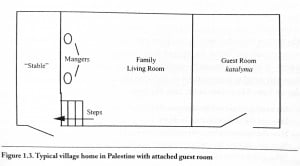
Moreover, the actual design of Palestinian homes (even to the present day) makes sense of the whole story. As Bailey explores in his Jesus Through Middle-Eastern Eyes, most families would live in a single-room house, with a lower compartment for animals to be brought in at night, and either a room at the back for visitors, or space on the roof. The family living area would usually have hollows in the ground, filled with straw, in the living area, where the animals would feed. This kind of one-room living with animals in the house at night is evident in a couple of places in the gospels. In Matt 5.15, Jesus comments: Neither do people light a lamp and put it under a bowl. Instead they put it on its stand, and it gives light to everyone in the house. This makes no sense unless everyone lives in the one room! And in Luke’s account of Jesus healing a woman on the Sabbath (Luke 13.10–17), Jesus comments: Doesn’t each of you on the Sabbath untie your ox or donkey from the manger [same word as Luke 2.7] and lead it out to give it water? Interestingly, none of Jesus’ critics respond, ‘No I don’t touch animals on the Sabbath’ because they all would have had to lead their animals from the house. In fact, one late manuscript variant reads ‘lead it out from the house and give it water.’
What, then, does it mean for the kataluma to have ‘no space’? It means that many, like Joseph and Mary, have traveled to Bethlehem, and the family guest room is already full, probably with other relatives who arrived earlier. So Joseph and Mary must stay with the family itself, in the main room of the house, and there Mary gives birth. The most natural place to lay the baby is in the straw-filled depressions at the lower end of the house where the animals are fed. The idea that they were in a stable, away from others, alone and outcast, is grammatically and culturally implausible. In fact, it is hard to be alone at all in such contexts. Bailey amusingly cites an early researcher: Anyone who has lodged with Palestinian peasants knows that notwithstanding their hospitality the lack of privacy is unspeakably painful. One cannot have a room to oneself, and one is never alone by day or by night. I myself often fled into the open country simply in order to be able to think.
In the Christmas story, Jesus is not sad and lonely, some distance away in the stable, needing our sympathy. He is in the midst of the family, and all the visiting relations, right in the thick of it and demanding our attention. This should fundamentally change our approach to enacting and preaching on the nativity. But one last question remains. This understanding of the story has been around, even in Western scholarship, for a long, long time. Bailey cites William Thomson, a Presbyterian missionary to Lebanon, Syria and Palestine, who wrote in 1857: It is my impression that the birth actually took place in an ordinary house of some common peasant, and that the baby was laid in one of the mangers, such as are still found in the dwellings of farmers in this region. And Bailey notes that Alfred Plummer, in his influential ICC commentary, originally published in the late nineteenth century, agreed with this. So why has the wrong, traditional interpretation persisted for so long?
I think there are two main causes. In the first place, we find it very difficult to read the story in its own cultural terms, and constantly impose our own assumptions about life. Where do you keep animals? Well, if you live in the West, away from the family of course! So that is where Jesus must have been. Secondly, it is easy to underestimate how powerful a hold tradition has on our reading of Scripture.

Views of Bethlehem

King Herod

Views of Bethlehem

King Herod
All that you can see now is the hill in the background on the right, that looks like a volcano. Herod the Great, King of Judah (37Bc to 4BC) during the Roman period, was one of the greatest builders in the history of the Holy Land. Herodion was one of his monumental construction programs, built in the years 23-20BC in a large complex (50 Dunam - 5 Hectares) that included a fortress on the upper city and a palace and gardens in the lower city. The site was selected due to its high altitude, its location near the desert road, and to commemorate Herod's victory near the site (in 40BC). The fortress was initially built as a 7-story 35M high structure with walls that stood high above the natural hill. Later the external walls, facing the hillsides, were hidden behind a land fill that covered the walls from all sides. The earth was dug out from a nearby hill on the north side. The lower 2 floors are underground and supported by arches, while the upper floors were covered by wooden ceilings. Inside the fortress was Herod's private castle, with courtyards, rooms and bath houses. The fortress was connected to the lower city by a straight stairway which ascended on its north-east side. In the lower city were palace and office structures, a large Roman garden, and lake. The water to the lower city was supplied to the lake by an aqueduct from the area of Bethlehem. The water for the upper city was supplied by cisterns built on the north-east side, and fed from rainfall. Herod was buried in this site in a royal procession, as described by the historian Josephus Flavius.

*We did not have time to go inside Herod's excavation site. This one of it is not my photo; taken from the brochure.

14,000 infants were killed by King Herod in Bethlehem. The murdered infants thus became the first martyrs for Christ. The rage of Herod fell also on Simeon, who declared before everyone in the Temple that the Messiah had been born. When Simeon died, Herod would not give permission for him to be properly buried. On the orders of King Herod, the holy prophet and priest Zachariah was also killed. He was murdered in Jerusalem between the Temple and the altar (Mt. 23:35) because he would not tell the whereabouts of his son John. The wrath of God soon fell upon Herod himself: a horrid condition struck him down and he died, eaten by worms while still alive. Before his death, the impious king murdered the chief priests and scribes of the Jews, and also his brother, and his sister and her husband, and also his own wife Mariam, and three of his sons, and seventy men of wisdom who were members of the Sanhedrin. He initiated this bloodbath so that the day of his death would not be one of rejoicing, but one of mourning. The Bible says that one day, every knee will bow and every tongue will confess that Jesus Christ is Lord (Philippians 2:9-11).

And that concluded day one in Israel. A long, but very fulfilling day. We returned to the ship. As soon as I arrived, I went to get a quick bite to eat, the showered and headed to bed, as the next day would be an even earlier start. We have to be on the bus by 6am! Our ship set sail for Haifa.

Haifa
Perched on the slopes of Mount Carmel, the city of Haifa is a blend of cultures. As far back as the 9th century, Arabs and Jews were making a decent living in maritime trade. Peace and prosperity came to a halt once the Crusaders arrived. In the centuries that followed, Haifa fell into the hands of the Mamluk, the Ottomans, and even Napoleon. But in the 20th century thousands of Jews from Europe immigrated and by the time Israel had been established in 1948, the mostly Arab population had shifted. But again, my focus is not on Haifa. I was up very early and ready to see...
First I want to say, we had the most awesome tour guide this day. He was so informative and I could have listened to him all day. What a wealth of knowledge.
We arose to a beautiful bright and sunny gorgeous day. The drive into Nazareth was beautiful.


Leaving Nazareth
First view of the Sea of Galilee, but taking pictures into the sun...not a good photo from here.
As we drive along the edge of the sea, kept getting glimpses
Biblical significance:
The Jordan River runs through the land and history of the Bible, giving its waters a spiritual significance that sets it aside from other rivers. The Jordan is significant for Jews because the tribes of Israel in Joshua 3:17 "And the priests that bare the ark of the covenant of the Lord stood firm on dry ground in the midst of Jordan, and all the Israelite's passed over on dry ground, until all the people were passed clean over Jordan." It is significant for Christians because John the Baptist baptized Jesus in the waters of the Jordan. The prophets Elijah and Elisha also crossed the river dry-shod; and the Syrian general Naaman was healed of leprosy after washing in the Jordan at Elisha’s direction.
The Jordan River runs through the land and history of the Bible, giving its waters a spiritual significance that sets it aside from other rivers. The Jordan is significant for Jews because the tribes of Israel in Joshua 3:17 "And the priests that bare the ark of the covenant of the Lord stood firm on dry ground in the midst of Jordan, and all the Israelite's passed over on dry ground, until all the people were passed clean over Jordan." It is significant for Christians because John the Baptist baptized Jesus in the waters of the Jordan. The prophets Elijah and Elisha also crossed the river dry-shod; and the Syrian general Naaman was healed of leprosy after washing in the Jordan at Elisha’s direction.
Just east of the Jordan River, about 9 kilometers north of the dead sea modern explorers discovered the ruins and foundations of a large number of sandstone piers related to a Byzantine church built at the time of Emperor Anastasius (491-518 AD). This church was considered the most notable memorial church of St. John the Baptist on the east bank of the Jordan River. Theodosius (A.D 530) wrote “5 miles north of the Dead sea in the place where the Lord was baptized there is a single pillar and on the pillar an iron cross has been fastened, there too is the church of S. John the Baptist, which the Emperor Anastasius built: this church is very lofty, being built above large chambers, on account of the Jordan River when it overflows.” Although the pillar marking the place where the place where the Lord was baptized is not yet discovered, the archaeological and architectural remains match with what was described by Theodosius.
Forty years later (A.D 570) Antoninus Martyr of Piacenza. “The marble steps discovered and preserved recently closely match with what was described over 1400 years ago. The marble steps actually descend eastward and the waters of the arrive at the lowest parts of the marble steps from the southwest when the river overflows.
A 100 years later Arculfus of France (A.D 670) gave important notes, saying: “At the edge of the river is a small square church, built, as is said, on the spot where the garments of the Lord were taken care of at the time when He was baptized. This is raised, so as to be uninhabitable, on four stone vaults, standing above the waters which flow below”. We can see the two northern piers while only the foundations of the southern piers where discovered recently at the end of, and symmetrical with, the marble steps. Hence, in plan we have a huge cruciform baptismal pool, where pilgrims would descend through the marble steps and be baptized. At the lower parts of the two northern piers, the original plaster was discovered on which thousands of cross marks are still visible, these cross marks must have been left by believers who were baptized at this holy spot. In fact this is the only cruciform baptismal pool on earth that used the river water for baptism.
Sea of Galilee

Also known as Bahr Tubariya, Ginnosar, Lake of Galilee, Lake of Gennesaret, Lake of Gennesar, Sea of Chinnereth, Sea of Chinneroth, Sea of Kinnereth, Sea of Tiberias, Lake of Tiberias, Waters of Gennesaret, Yam Kinneret. The Sea of Galilee is fed by the Jordan River, rainfall and springs on the northern side. More properly designated a lake, the Kinneret (the OT and modern name) is 13 miles long and 8.1 miles wide.

And Capernaum
Capernaum was a large Galilean fishing village and busy trading center. This place is of special interest to Christians because of its frequent mention in the history of Jesus Christ. Peter, Andrew, James and John also lived here. It played a unique and important part in Christ’s life and ministry, and in his outreach to the people of Israel. The inhabitants of Capernaum, including various high ranking citizens, were given unique and abundant opportunities to hear Jesus Christ’s message firsthand and witness His awesome power and love.
Two and ½ miles (4 km) from the Jordan River, Capernaum stood on the northwestern shore of the Sea of Galilee (modern Lake Kinneret, which the Bible also called the lake of Gennesaret, Sea of Chinnereth and the Sea of Tiberias). The ancient city of Capernaum was abandoned about a thousand years ago or more, and was rediscovered by archaeologists beginning in the 1800s. The Gennesaret area was one of the most prosperous and crowded districts of Israel. Capernaum lay on the great Via Maris highway between Damascus (Syria) and Caesarea Maritima on the Mediterranean Sea, and between Tyre and Egypt.
Capernaum was a large Galilean fishing village and busy trading center. This place is of special interest to Christians because of its frequent mention in the history of Jesus Christ. Peter, Andrew, James and John also lived here. It played a unique and important part in Christ’s life and ministry, and in his outreach to the people of Israel. The inhabitants of Capernaum, including various high ranking citizens, were given unique and abundant opportunities to hear Jesus Christ’s message firsthand and witness His awesome power and love.
Two and ½ miles (4 km) from the Jordan River, Capernaum stood on the northwestern shore of the Sea of Galilee (modern Lake Kinneret, which the Bible also called the lake of Gennesaret, Sea of Chinnereth and the Sea of Tiberias). The ancient city of Capernaum was abandoned about a thousand years ago or more, and was rediscovered by archaeologists beginning in the 1800s. The Gennesaret area was one of the most prosperous and crowded districts of Israel. Capernaum lay on the great Via Maris highway between Damascus (Syria) and Caesarea Maritima on the Mediterranean Sea, and between Tyre and Egypt.
Customs taxes were collected from travelers at this crossroads (Matthew 9:9). This was the job of Levi, the tax collector, who became Christ’s disciple and was later named Matthew. Jews criticized Jesus for befriending him and other tax collectors. Caravans stopped at Capernaum to resupply themselves with produce and dried fish. At the lake shore, where Peter and other fishermen worked, archaeologists discovered a fish sales area.
 Capernaum was the center of Jesus activities in the Galilee and his town during that time. Jesus taught in the local synagogue. Jesus made Capernaum his home during the years of his ministry: "And leaving Nazareth, he came and dwelt in Capernaum, which is upon the sea coast, in the borders of Zabulon and Nephthalim:" (Matt 4:12-17; Luke 4:16-31). It was the scene of many acts and incidents of his life (Matthew 8:5, 14,15; 9:2-6, 10-17; 15:1-20; Mark 1:32-34, etc.).

On another occasion word spread that Jesus was teaching in a certain Capernaum home. The building was soon packed with people. Four men carrying a paraplegic wanted to have him heal their friend but could not get to him due to the crowd of people. They decided to go on top of the house and dig their way through the roof. Once they had opened a sufficiently large enough hole they slowly lowered their friend's pallet in front of where Christ was sitting. Seeing their great faith, he immediately healed their friend and said his sins were forgiven. Some self-righteous religious leaders, who heard Jesus say the paraplegic's sins were forgiven, thought he was blaspheming God. Christ quickly chastised the men for their evil thoughts and boldly asserted he had the authority to forgive sin (Mark 2:3-12, Luke 5:17-25).
It was also in the city that, because of the great faith of a Roman Centurion, Jesus did not need to visit the man's servant who had palsy but simply commanded he be healed (Matthew 8: 5-13). Other miracles which occurred in the city included the healing of the nobleman's son (John 4:46-54), Peter's mother-in-law made well (Matthew 8:14-15), and the synagogue ruler's daughter brought back to life (Matthew 9:23-25).
It was also the home of the first disciples Jesus called. At least five of the twelve apostles Jesus called to follow him lived in Capernaum - the fishermen, James and John (brothers), Andrew and Peter (brothers) and Matthew the tax collector (who as Levi collected taxes in the customs office).
Capernaum later fell into ruin. A third-century report called the town “despicable; it numbers only seven houses of poor fishermen”. It was later resettled but again fell into disrepair. The ruins lay undiscovered until 1838, when a visiting scholar gave this description: “The whole place is desolate and mournful . . . .” Today an ultra-modern Catholic church, perched on eight sturdy pillars, hovers protectively over an excavation site. It is believed to have been the site of Peter’s house, where Jesus would have lodged.
Excavations show that one room in this interlinked complex had been singled out since the middle of the 1st century. Graffiti scratched on its plaster walls referred to Jesus as Lord and Christ (in Greek). It is suggested that this room was venerated for religious gatherings as a house church. If so, it would have been the first such example in the Christian world.
In the 5th century AD a church was built over St. Peter's house. It has the shape of an Octagon, which was typical of early churches and structures (such as Kathisma south of Jerusalem, and even the Dome of the Rock). Erected in the 4th or 5th centuries, this impressive structure with ornately carved decorations is the largest synagogue discovered in Israel.
Its white limestone, carted from a distant quarry, contrasts with the local black basalt of the synagogue Christ knew. That original synagogue was built by a Roman centurion, the same centurion who had his servant healed after a declaration of faith that amazed Jesus (Luke 7:1-10).
Literary sources and recent archaeological discoveries make the identification of the house of St. Peter in Capernaum virtually certain.
The house was built at the very end of the Hellenistic period (first century B.C.). In the second half of the first century A.D. some peculiar features set apart this building from all the others so far excavated in Capernaum. Here, in fact, the pavements received floors of lime several times. Interesting enough, many pieces of broken lamps were found in the thin layers of lime. …One hundred and thirty-one inscriptions were found. They were written in four languages, namely: in Greek (110), Aramaic (10), Estrangelo (9), and Latin (2).
The name of Jesus appears several times. He is called Christ, the Lord, and the Most High God. An inscription in Estrangelo mentions the Eucharist.
There are also symbols and monograms, namely: crosses of different forms, a boat, the monogram of Jesus. The name of St. Peter occurs at least twice: his monogram is written in Latin but with Greek letters. In another graffito St. Peter is called the helper of Rome. A third inscription mentions Peter and Berenike. This Peter, however, might be the name of a pilgrim. On several hundred pieces of plaster, decorative motifs appear. The colors employed are: green, blue, yellow, red, brown, white and black. Among the subjects one can distinguish floral crosses, pomegranates, figs, trifolium, stylized flowers and geometric designs such as circles, squares, etc.
…At the beginning of the fifth century, the house of St. Peter was still standing, but it had been previously changed into a church. This we learn from Eteria, a Spanish pilgrim, who wrote in her diary: “In Capernaum, the house of the Prince of the Apostles (=St. Peter) became a church. The walls, however, (of that house) have remained unchanged to the present day.”
 Mary, the mother of Jesus, made her way to Capernaum with her other sons (Matthew 12:46, 48-49). It was here that Christ uttered the memorable words, “Who is my mother? and who are my brethren? And he stretched forth his hand toward his disciples, and said, Behold my mother and my brethren!”
Other Miracles of Christ in Capernaum: Cast evil spirit from a man in the local synagogue on the Sabbath (Mark 1:21-28; Luke 4:33-36) and the demon confessed “I know thee who thou art; the Holy One of God.” (Luke 4:34). Simon’s mother-in-law instantly healed on the Sabbath of a serious fever and then she immediately helped serve Simon’s guests (Luke 4:38-39). All the sick of Capernaum came to Simon’s house after the end of Sabbath (sunset), and all were healed by Jesus (Luke 4:40-41), as “all the city was gathered together at the door” (Mark 1:29-34). Demons cast out of many people, and the devils confessed that Christ is the Son of God (Luke 4:41). Dead daughter of Jairus raised (Mark 5:22; Luke 8:41). Paralyzed man let down through the roof and instantly fully healed (Mark 2:1-12). Jesus caused four of disciples to catch fish in a miraculous way (Luke 5:1-11). Through a fish, Jesus supplied tribute tax money needed by Peter (Matthew 17:24-27). Healing of the centurion’s servant afflicted with palsy (Matthew 8:5-13). Healing of the son of a nobleman in the King’s court (Herod Antipas) (John 4:46-54).
Despite the unique number of evidences our Lord presented to them, most of the people of Capernaum lacked faith in Him and remained unrepentant disbelievers. Because they turned so strongly away from the uniquely gracious light given, they were strongly judged.
“For unto whomsoever much is given, of him shall be much required…” (Luke 12:48). Thus, along with nearby Chorazin and Bethsaida, Capernaum received a very stern warning from Jesus (Matthew 11:21-24). “It shall be more tolerable for the land of Sodom in the day of judgment, than for thee.”
Ultimately, the cities were all destroyed, and Capernaum became virtually uninhabited ruins for centuries. Today, Capernaum’s inhabitants include a Greek Orthodox Church and a Franciscan Monastery.
…At the beginning of the fifth century, the house of St. Peter was still standing, but it had been previously changed into a church. This we learn from Eteria, a Spanish pilgrim, who wrote in her diary: “In Capernaum, the house of the Prince of the Apostles (=St. Peter) became a church. The walls, however, (of that house) have remained unchanged to the present day.”
Other Miracles of Christ in Capernaum: Cast evil spirit from a man in the local synagogue on the Sabbath (Mark 1:21-28; Luke 4:33-36) and the demon confessed “I know thee who thou art; the Holy One of God.” (Luke 4:34). Simon’s mother-in-law instantly healed on the Sabbath of a serious fever and then she immediately helped serve Simon’s guests (Luke 4:38-39). All the sick of Capernaum came to Simon’s house after the end of Sabbath (sunset), and all were healed by Jesus (Luke 4:40-41), as “all the city was gathered together at the door” (Mark 1:29-34). Demons cast out of many people, and the devils confessed that Christ is the Son of God (Luke 4:41). Dead daughter of Jairus raised (Mark 5:22; Luke 8:41). Paralyzed man let down through the roof and instantly fully healed (Mark 2:1-12). Jesus caused four of disciples to catch fish in a miraculous way (Luke 5:1-11). Through a fish, Jesus supplied tribute tax money needed by Peter (Matthew 17:24-27). Healing of the centurion’s servant afflicted with palsy (Matthew 8:5-13). Healing of the son of a nobleman in the King’s court (Herod Antipas) (John 4:46-54).
Despite the unique number of evidences our Lord presented to them, most of the people of Capernaum lacked faith in Him and remained unrepentant disbelievers. Because they turned so strongly away from the uniquely gracious light given, they were strongly judged.
“For unto whomsoever much is given, of him shall be much required…” (Luke 12:48). Thus, along with nearby Chorazin and Bethsaida, Capernaum received a very stern warning from Jesus (Matthew 11:21-24). “It shall be more tolerable for the land of Sodom in the day of judgment, than for thee.”
Ultimately, the cities were all destroyed, and Capernaum became virtually uninhabited ruins for centuries. Today, Capernaum’s inhabitants include a Greek Orthodox Church and a Franciscan Monastery.
There are many many artifacts to be seen here. I like this one of the Olive press. Wheel in a wheel...
People called Jesus a carpenter (Mark 6:3), and He was known as a carpenter’s son (Matthew 13:55). There is some evidence that the Greek word used for “carpenter” (tekton) could also be translated more broadly as “artisan,” “contractor,” or “handyman.” It is possible, therefore, that Jesus and Joseph were the sort of men you call when something needs to be fixed—be it made of wood, stone, or something else. It is also possible that they acted as civil engineers, even designing bridges or other structures that were needed by the people of the town. This throws an interesting light on Jesus’ later comments about the temple. As they were going past the temple, His disciples, perhaps knowing of His interests and past profession, pointed out the grandeur of the great buildings. Jesus told His disciples that those structures would all be thrown down (Mark 13:2). In addition to being a prophecy, Jesus’ words were perhaps a reminder of the importance of the spiritual over the physical.
“But there will be no gloom for her who was in anguish. In the former time he brought into contempt the land of Zebulun and the land of Naphtali, but in the latter time he has made glorious the way of the sea, the land beyond the Jordan, Galilee of the nations” (Isaiah 9:1). This is a prophecy, quoted in Matthew 4:15, that promises that joy, a broken rod of oppression, and a child called Wonderful Counselor, Mighty God, Everlasting Father, Prince of Peace will come to the Sea of Galilee. Some 700 years later, Jesus began His ministry there, in Galilee, by the sea.
It was the Sea of Galilee that Jesus walked on (Matthew 14:22–33). After Jesus fed the five thousand, He sent His disciples across the sea while He withdrew from the crowd. The sea became rough, and the disciples had only rowed three or four miles when they saw Jesus walking on the water, set to overtake them. Peter asked to join Him on the water, but once out of the boat Peter became frightened and started sinking. Jesus saved him, and they both climbed into the boat. Instantly, the winds died down, and they were across the water to the other side.
On another occasion, again when Jesus wanted to cross the Sea of Galilee from west to east, He was so tired that He fell asleep in the boat (Mark 4:35–41). A great storm rose up, and the disciples woke the Lord, afraid for their lives. Jesus rebuked them for their lack of faith and then rebuked the wind and calmed the sea. The disciples were amazed that even the sea obeyed Him.
The Sea of Galilee was a key place for Jesus’ disciples. Jesus called Simon (Peter), Andrew, James, and John to be His disciples while they were working as fishermen (Matthew 4:18–22). Later, Jesus found Levi (Matthew) sitting at a tax booth beside the sea and called him (Mark 2:13–17). A short while after, Jesus went to a mountain above the sea to winnow His followers to twelve disciples (Mark 3:13–19). Finally, at the end of it all, after the resurrection, Jesus went to the Sea of Galilee and found Peter, Thomas, Nathanael, James, John, and two other disciples fishing. There on the seaside, Jesus cooked them breakfast, reconciled Peter to Himself, and gently chastised John for worrying too much about his fate.
A storm on the Sea of Galilee is described in Mark 4:37. Luke 8 describes the wind and raging waves during this storm. Matthew calls it a furious storm without warning. Such storms result from differences in temperatures between the seacoast and the mountains beyond. The Sea of Galilee lies 680 feet below sea level. It is bounded by hills, especially on the east side where they reach 2000 feet high. These heights are a source of cool, dry air.
Along the shore south of Capernaum, in a cove with the appearance of a natural amphitheater, an amateur archeologist and a sound engineer determined to test the following acoustic possibility: that when great multitudes crowded to the shore of the Sea of Galilee and Jesus withdrew from them in a boat, that they would be able to hear him distinctly. The hypothesis was tested by measuring the sound of bursting balloons all the way up the steep slope, at varying distances until the sound engineer reached the present-day road, about one hundred yards away. The archeologist whose task was to burst the balloons stood on a large rock protruding from the cove's waters about ten yards from the center of the arc composing the shoreline at that time. The bright-colored balloons attracted the attention of motorists driving along the Capernaum-Tiberias road and some even did "double-takes" at the unexpected sight by the sea. The spontaneous reactions of passers-by turned out to be acoustic tests by themselves. In one example, in a UN car driving north, the driver turned to his companion and asked, "What's that guy doing down there?" The companion replied, "I don't know! He's just standing there and holding some balloons!" This exchange was heard clearly by the tester on the rock holding the balloons, some 100 yards away, even though he couldn't distinguish the occupants of the car. At the end of the experiment, the sound engineer concluded that the bowl-like setting of the cove where Jesus sat in a boat a short distance away while addressing a steeply sloped audience would have created an optimal situation for enhanced speech communication.
When a person's voice is projected in a line that grazes the audience's heads, the high frequencies which distort sound would be absorbed by hair, clothing and this case, vegetation. And lower frequencies which also distort sound would be absorbed by the crowds sitting in a steeply-raked formation. Thus, they concluded, Jesus could have been both seen and heard clearly, by some 5 to 7 thousand people! This number is certainly compatible with the Gospels' description of "great crowds."
 Matthew 19:27 Then answered Peter and said unto him, Behold, we have forsaken all, and followed thee; what shall we have therefore? 28 And Jesus said unto them, Verily I say unto you, That ye which have followed me, in the regeneration when the Son of man shall sit in the throne of his glory, ye also shall sit upon twelve thrones, judging the twelve tribes of Israel. 29 And every one that hath forsaken houses, or brethren, or sisters, or father, or mother, or wife, or children, or lands, for my name's sake, shall receive an hundredfold, and shall inherit everlasting life. 30 But many that are first shall be last; and the last shall be first.
 What an opportunity to stand on this sea shore, and know that Jesus and his disciples stood here.

We then left the sea shore and took a drive up the hills surrounding it. I got a few photos from there as well. These next two photos, are of crumbling ruins of ancient villages.
 All that is left are a few piles of stones.

Then we drove to the area where Jesus possibly delivered the Sermon on the Mount
 The “Sermon on the Mount” is recorded in Matthew 5-7 and Luke 6. The alleged discrepancy between Matthew’s version being on a hill and Luke’s being on a level place is easily reconciled with observation of many level places on the Galilean hillsides. Scripture gives no indication of the exact location of this event, but the Byzantines built a church to commemorate it at the bottom of the hill. Some of Napoleon’s men placed it on the nearby Arbel mountain.
 The Mt. of Beatitudes overlooks the four-mile long Plain of Gennesaret, an area famed for its fertility. Josephus said this plain was the location of “nature’s crowning achievement.” Several times the New Testament records that Jesus was in this area including when he healed the multitudes here and faced Pharisaic condemnation for ritual impurity (Mark 6-7).

Just by a stroke of luck I got this photo. We had left the hillside, and were coming around the shore of the sea heading for lunch. These beautiful plants were here and I would have loved to stop and taken a few photos, but since I couldn't, I just grabbed my camera and started clicking through the window. I had taken a dozen others, hoping for a good one. I was sooooo thrilled to get this shot!

We then arrived at the restaurant for our lunch. Two days now, we have had the absolute best lunches here in Israel. I loved this food!

After lunch, I wandered down to the sea shore one more time to a couple more photos. The weather was shifting and the wind had picked up. The previously calm waters were getting a bit of ripple now, and the sky was starting to darken. By the time we arrived back to our ship, it was raining.
 I could have stayed all day here. It was so beautiful and peaceful. My mind was full; doubt I could have taken in any more information, but my heart was happy.
 Last stop before we left the area, of course, was a shop. I don't buy many souvenirs, as I don't want to carry or keep them, however, I will buy a coffee mug from time to time. Here they didn't have any of Galilee or I would have purchased one. I did however, buy a jar of date syrup... tastes a lot like molasses. This is also where I purchased refrigerator magnets as a memento to bring back to my church group here in Bari. They loved them.
When a person's voice is projected in a line that grazes the audience's heads, the high frequencies which distort sound would be absorbed by hair, clothing and this case, vegetation. And lower frequencies which also distort sound would be absorbed by the crowds sitting in a steeply-raked formation. Thus, they concluded, Jesus could have been both seen and heard clearly, by some 5 to 7 thousand people! This number is certainly compatible with the Gospels' description of "great crowds."


Refrigerator magnets & Date Syrup
They also had this table set up for Passover meal. Very beautiful

And then we were leaving to go back to the ship. Just as we left the area, the storm moved in. I had walked down to the shore here at the restaurant and had to 'hurry' back to the bus.
Here at this location, we were only about 45 miles from Syria.
It rained all the way back and was still raining when we arrived in Haifa. So glad it held off all day... what a wonderful day it was.
Now we have arrived back in Haifa and are aboard the ship. Nice place to get photos from.
Happy to say my time here in Israel was safe, however, there was a bit of risk coming here.
On April 7th, while we were still traversing the Red Sea and the Pirates ☺, the USA had bombed Syria. So needless to say, this was definitely on my mind, since at one point today, we were only 45 miles from the Syrian border.
Then just two days before we arrived on April 13th and traveled to the West Bank (Palestine where Bethlehem is located), this warning was issued:
***Israel, The West Bank and Gaza Travel Warning LAST UPDATED: APRIL 11, 2017
Within Israel and the West Bank, the possibility of random violence continues to exist and can happen without warning. U.S. citizens have been killed and wounded in recent attacks, though there is no indication they were specifically targeted based on nationality. Perceived religious affiliation was a factor in some of the attacks, and the majority of recent attacks have targeted uniformed Israeli security forces often in proximity to checkpoints throughout Jerusalem and the West Bank or near religious sites significant to multiple faiths. Attacks were carried out using knives, vehicles, and guns. Israeli security forces reacted with deadly force, which has resulted in some bystanders being injured or killed in the crossfire. U.S. citizens should stay abreast of current events in order to know what areas to avoid when traveling throughout the region. U.S. citizens planning to travel to Israel, the West Bank, or Gaza should consult the detailed information concerning entry and exit difficulties in the Country Specific Information (CSI). The CSI also provides detailed guidance on crime and safety conditions within Israel, Jerusalem, the West Bank, and Gaza. U.S. government employees are prohibited from personal travel into Jerusalem’s Old City on Fridays during the Muslim month of Ramadan. The U.S. government occasionally restricts travel for its employees to the Old City based on the current security environment; U.S. government employees are prohibited from using public buses and public bus terminals throughout Israel and the West Bank; and U.S. government employees must observe additional security requirements if traveling for any reason to the following locations: within 7 miles of the Gaza demarcation line; within 1.5 miles of the Lebanon border; on or east of Route 98 in the Golan; and within 1.5 miles of the Egypt border along the Sinai (including all portions of Route 10 and portions of Route 12).
Within Israel and the West Bank, the possibility of random violence continues to exist and can happen without warning. U.S. citizens have been killed and wounded in recent attacks, though there is no indication they were specifically targeted based on nationality. Perceived religious affiliation was a factor in some of the attacks, and the majority of recent attacks have targeted uniformed Israeli security forces often in proximity to checkpoints throughout Jerusalem and the West Bank or near religious sites significant to multiple faiths. Attacks were carried out using knives, vehicles, and guns. Israeli security forces reacted with deadly force, which has resulted in some bystanders being injured or killed in the crossfire. U.S. citizens should stay abreast of current events in order to know what areas to avoid when traveling throughout the region. U.S. citizens planning to travel to Israel, the West Bank, or Gaza should consult the detailed information concerning entry and exit difficulties in the Country Specific Information (CSI). The CSI also provides detailed guidance on crime and safety conditions within Israel, Jerusalem, the West Bank, and Gaza. U.S. government employees are prohibited from personal travel into Jerusalem’s Old City on Fridays during the Muslim month of Ramadan. The U.S. government occasionally restricts travel for its employees to the Old City based on the current security environment; U.S. government employees are prohibited from using public buses and public bus terminals throughout Israel and the West Bank; and U.S. government employees must observe additional security requirements if traveling for any reason to the following locations: within 7 miles of the Gaza demarcation line; within 1.5 miles of the Lebanon border; on or east of Route 98 in the Golan; and within 1.5 miles of the Egypt border along the Sinai (including all portions of Route 10 and portions of Route 12).
***Then on the 14th, the second day we were here, "A 21-year-old female British tourist was killed Friday afternoon after being stabbed during a terror attack on the Jerusalem light rail, a few meters outside the Old City, where tens of thousands of visitors from across the globe are observing Passover and Easter. According to Police spokesman Micky Rosenfeld, the 57-year-old suspect from east Jerusalem’s Ras al-Amud neighborhood got on the light rail heading toward the center of town at Damascus Gate at approximately 1 p.m. “As the tram approached Kikar Tzahal, he pulled out a knife and stabbed the female tourist in the upper body, critically wounding her,” said Rosenfeld. “She was treated at the scene by paramedics and rushed to Hadassah University Medical Center in Jerusalem, where she died of her wounds.”
Friday’s murder marks the second stabbing attack this month by a Palestinian terrorist near the Old City. On April 1, two Jewish teenagers and a police officer were stabbed in the Muslim Quarter by an Arab assailant who was shot and killed. Four days earlier, Siham Rateb Nimir, an Arab 49-year-old east Jerusalem woman, was shot dead by Border Police after unsuccessfully attempting to stab an officer stationed near Damascus Gate with scissors. Meanwhile, on April 6, a terrorist rammed his vehicle into two soldiers standing guard by a bus stop near the entrance to the West Bank settlement of Ofra, resulting in the death of Sgt. Elchai Teharlev. A second soldier sustained light wounds.
Prior to Passover, security forces predicted an uptick in violence in the capital during the holiday. Over 3,500 officers from multiple units have been dispatched throughout the city, with an emphasis on the Old City, since Monday. “Heightened security is continuing in Jerusalem to prevent any other attacks,” said Rosenfeld.
Friday’s murder marks the second stabbing attack this month by a Palestinian terrorist near the Old City. On April 1, two Jewish teenagers and a police officer were stabbed in the Muslim Quarter by an Arab assailant who was shot and killed. Four days earlier, Siham Rateb Nimir, an Arab 49-year-old east Jerusalem woman, was shot dead by Border Police after unsuccessfully attempting to stab an officer stationed near Damascus Gate with scissors. Meanwhile, on April 6, a terrorist rammed his vehicle into two soldiers standing guard by a bus stop near the entrance to the West Bank settlement of Ofra, resulting in the death of Sgt. Elchai Teharlev. A second soldier sustained light wounds.
Prior to Passover, security forces predicted an uptick in violence in the capital during the holiday. Over 3,500 officers from multiple units have been dispatched throughout the city, with an emphasis on the Old City, since Monday. “Heightened security is continuing in Jerusalem to prevent any other attacks,” said Rosenfeld.
Before we even got out of the harbor, the rain was back. And it stayed with us all the next day.
At Sea, April 15th
It rained all night after we left Israel and all day Saturday as we cruised along, but still was a lovely day at sea! I got rested up last night and had a very relaxing day. Heading to Athens for Sunday, where lovely friends will meet me for the day. Next blog post will be much shorter and quicker of my day in Athens and Venice, as I didn't do any touring those days. I've been to both places a few times before now. I will be returning to those places again in the near future also.
According to Genesis 15:18 and Joshua 1:4, the land God gave to Israel included everything from the Nile River in Egypt to Lebanon (south to north) and everything from the Mediterranean Sea to the Euphrates River (west to east). So, what land has God stated belongs to Israel? All of the land modern Israel currently possesses, plus all of the land of the Palestinians (the West Bank and Gaza), plus some of Egypt and Syria, plus all of Jordan, plus some of Saudi Arabia and Iraq. Israel currently possesses only a fraction of the land God has promised.


No comments:
Post a Comment